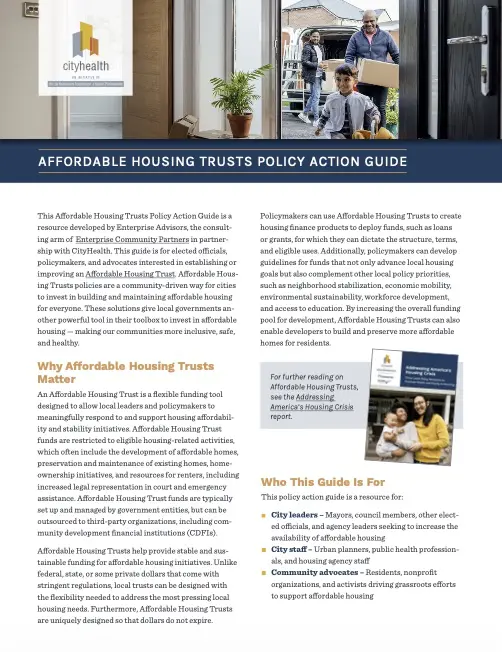


Affordable Housing Trusts Policy Action Guide

This Affordable Housing Trusts Policy Action Guide is a resource developed by Enterprise Advisors, the consult-ing arm of Enterprise Community Partners in partnership with CityHealth. This guide is for elected officials, policymakers, and advocates interested in establishing or improving an Affordable Housing Trust. Affordable Housing Trusts policies are a community-driven way for cities to invest in building and maintaining affordable housing for everyone. These solutions give local governments an-other powerful tool in their toolbox to invest in affordable housing — making our communities more inclusive, safe, and healthy.

Excerpts of the policy guide are below. You can download the full guide here.

Produced in partnership with Enterprise Advisors, the consulting arm of Enterprise Community Partners.

Why Affordable Housing Trusts Matter

Healthy family in safe rental housingAn Affordable Housing Trust is a flexible funding tool designed to allow local leaders and policymakers to meaningfully respond to and support housing affordability and stability initiatives. Affordable Housing Trust funds are restricted to eligible housing-related activities, which often include the development of affordable homes, preservation and maintenance of existing homes, homeownership initiatives, and resources for renters, including increased legal representation in court and emergency assistance. Affordable Housing Trust funds are typically set up and managed by government entities, but can be outsourced to third-party organizations, including community development financial institutions (CDFIs).

Affordable Housing Trusts help provide stable and sustainable funding for affordable housing initiatives. Unlike federal, state, or some private dollars that come with stringent regulations, local trusts can be designed with the flexibility needed to address the most pressing local housing needs. Furthermore, Affordable Housing Trusts are uniquely designed so that dollars do not expire.

Policymakers can use Affordable Housing Trusts to create housing finance products to deploy funds, such as loans or grants, for which they can dictate the structure, terms, and eligible uses. Additionally, policymakers can develop guidelines for funds that not only advance local housing goals but also complement other local policy priorities, such as neighborhood stabilization, economic mobility, environmental sustainability, workforce development, and access to education. By increasing the overall funding pool for development, Affordable Housing Trusts can also enable developers to build and preserve more affordable homes for residents.

Affordable Housing Trusts Key Actions

Step 1: Define your Affordable Housing Trust

Creating an Affordable Housing Trust begins with clearly defining its goals and eligibility criteria. A well-structured trust should align its goals with local housing needs, addressing gaps in affordability, housing stability, and access for low- and moderate-income households. Developing or utilizing existing resources, such as housing needs assessments, consolidated plans, or neighborhood plans can pro-vide meaningful direction for how an Affordable Housing Trust should prioritize their resources. By establishing clear, measurable goals — such as increasing renter housing stability, expanding homeownership opportunities, preserving existing units, supporting age-in-place rehabilitation, or providing gap financing — the trust can ensure its resources are directed toward the most pressing needs.

Goals help define the criteria used to evaluate funding requests and proposals. Eligibility requirements could specify income thresholds, target populations (such as seniors, people with disabilities, or families at risk of displacement), and geographic priorities. While these requirements help direct resources toward the trust’s goals, overly restrictive criteria may limit impact. Striking the right balance between alignment and flexibility is essential to maximizing impact.

Step 2: Identify Stakeholders and Build Coalitions

Prioritizing Meaningful Community Engagement

When developing an Affordable Housing Trust policy, it is important to create an inclusive community and stakeholder engagement strategy to help shape the content of the policy, build political support and community trust, and foster equitable outcomes. It is critical, therefore, to design an engagement strategy that reaches all populations within the community, particularly residents the program is intended to serve. While moving toward the legislative process, local governments should also engage other stakeholders (e.g., non-profit organizations, tenant coalitions, public agencies, developers, legal aid organi-zations, housing advocates, and other affordable housing professionals).

Once a policy has been passed, additional engagement for the development of annual program guidelines and priorities can be built in as well. This can include focus groups or other community engagement events that allow residents to weigh in on application and underwriting protocols. Participatory budgeting is another method to continue to engage the community in decision making, allowing residents to develop, pitch, and vote on projects to receive funding from the Affordable Housing Trust.

Building a Multi-Stakeholder Oversight Board

An image of a house in a neighborhood with trees and a city skyline in the backgroundEffective Affordable Housing Trust policies promote accountability and transparency in allocation, use, and evaluation of funding. One method to help achieve this is by requiring that the trust have a multi-stakeholder oversight board with clearly defined roles and respon-sibilities. In designing the policies for the trust, policy-makers can be explicit as to the perspectives, skills, roles, and housing organizations they want to have represent-ed across the oversight body. This could include board members with lived experience with housing instability or affordable housing programs, social service providers, nonprofit and for-profit developers, attorneys, contrac-tors or builders, community land trust leaders, property managers, and public sector staff. Policies should also be clear about how (and for how long?) representatives are appointed. Board members are often appointed by the mayor or city council or appointed ex officio based on their roles at specified housing organizations.
Necessary resources, including staffing and funding, should be allocated to support the oversight board. Additionally, due to the role of the oversight board, local governments should consider what appropriate guard-rails are needed to minimize conflicts of interest and other potential abuses of power. Furthermore, meetings of the oversight board should be public, accessible, and meet all open meeting laws.

Step 3: Establish a Revenue Source

Identifying a reliable revenue source to fund an Affordable Housing Trust is key to the policy’s success and longevity. While Affordable Housing Trusts are effective due to their flexibility, that flexibility can only be maintained through a stable and consistent source of funding. As development costs and interest rates have increased and federal funding for affordable housing has declined, affordable housing developments and programs require additional subsidy or financing, often from Affordable Housing Trusts.

Dedicated, recurring revenue sources, established through legislation or ordinance, are most effective for an Affordable Housing Trust. Dedicated funding reduces risk and removes the need for advocates to continually fight for scarce public resources. The following table details some common funding mechanisms for Affordable Housing Trusts. However, their application may vary depending on each state’s legal and policy landscape.

COMMON FUNDING MECHANISM
MECHANISMHOW IT WORKSCHALLENGESEXAMPLES
BondsThe proceeds from the sale of municipal bonds would create funding for the affordable housing trust.Bonds that require voter approval can be vulnerable to political pressures. San Francisco Affordable Housing General Obligation Bond
General Fund allocationsDesignating a portion of a government’s budget to be allocated to the housing trustLike bonds, funds appropriated from the General Fund may risk impacts from political changes. Louisville General Fund Appropriation
Real Estate Transfer TaxesCharges imposed at the point of a real estate transfer relative to the value of property. Certain municipalities apply real estate transfer fees to transactions above a specified price threshold. These fees may be imposed on either the seller, buyer, or both.Establishing these types of taxes may face political pushback.Baltimore Yield Tax
Linkage FeesOften imposed on non-residential or market rate residential developers to compensate for the impact their projects may have on local housing needs and supply. Linkage fees are associated with policies that do not require developers to include affordable units onsite.Development activity and collected fees may vary year-to-year, making it difficult to project annually generated revenue. Los Angeles Affordable Housing Linkage Fee
Property TaxesLevied on the value of real property such as land and buildings, both commercial and residential, or personal property, such as business equipment and noncommercial motor vehicles.Raising property taxes to support affordable housing may be challenging politically. Denver Property Tax
Recording FeesFees generated on mortgage, deed, and other real estate transaction recordings are used to fund the Affordable Housing Trust.Fees may vary year-to-year, making it difficult to project annually generated revenue. Philadelphia Housing Trust Fund Fee
Short-term rental taxes and feesCollected on hotel lodging or through short-term rental platforms such as Airbnb and VRBO.This revenue source may only be effective in a market where short-term rentals are common. St. Louis Short-Term Rental Fee
Best Practices for Sustainable Funding

When designing an Affordable Housing Trust policy, it is helpful to establish annual revenue goals based on the latest data regarding local housing needs and shifts in market conditions. The most stable housing trusts are supported by revenue sources that do not require annual appropriations or frequent ballot measures. Additionally, it is considered a best practice to diversify funding sources for Affordable Housing Trusts to reduce the risk of significant impacts from changes to any single revenue stream.

Leveraging Partnerships

Local Affordable Housing Trusts have been highly effective in leveraging additional funding from other sources. The Center for Community Change estimated that every dollar spent by an Affordable Housing Trust attracts approximately $7.50 of additional private, nonprofit, and governmental investment. Seeking out partnerships in the private and philanthropic sectors is an effective way to strengthen an Affordable Housing Trust. Partners may include financial institutions, community foundations, or major employers. Local governments can also coordinate with state and county governments to align funding.

Enhancing Funding Flexibility

Unlike other housing funding sources that are restricted to a particular program or use, Affordable Housing Trusts can offer greater flexibility, allowing a single funding source to support a range of housing initiatives. To fully leverage this flexibility, Affordable Housing Trusts should offer a variety of funding structures to awardees receiving Affordable Housing Trust funds. For example, some projects may need a grant to support property acquisition or other predevelopment costs. Other projects may prefer low-cost capital through a flexible loan product.

Step 4: Establish an Administration & Governance Structure

Decisions regarding the administration and governance of an Affordable Housing Trust can significantly impact policy implementation. Clearly defining goals is key to ensuring transparent and equitable implementation of the Affordable Housing Trust. Transparency helps build public trust, ensuring that funding decisions are guided by clear, objective criteria rather than political or ad hoc considerations. An equitable process ensures that funds are distributed in a way that maximizes long-term affordability, prevents displacement, and prioritizes communities historically excluded from housing opportunities. Consistent, effective administration of an Affordable Housing Trust is essential for ensuring proper resource allocation and maximizing the policy’s impact.

Options for Trust Governance

The structure of the governance system should ensure accountability, transparency, and responsiveness to community needs. Affordable Housing Trust administrators should adopt transparent and equitable processes for prioritizing and evaluating projects. Key factors for prioritization may include the level of affordability achieved (e.g., serving households at 30% of area median income or lower), the number of units created or preserved, the project’s proximity to jobs and transit, and alignment with local housing plans.

The following are some examples of trust governance models:

  • Oversight Board – Should include a diverse range of stakeholders including local government representatives, housing advocates, residents, and members of community organizations. (Example: DC Housing Production Trust Fund Advisory Board)
  • Advisory Committees – May review Affordable Housing Trust applications and advise on funding priorities, but in this structure city staff make final funding decisions. (Example: City of Asheville Afford-able Housing Advisory Committee)
  • Government Agency & City Council – Often a city agency is responsible for administering the fund, including developing scoring criteria and evaluating projects based on such. City Agency staff will then make award recommendations to the Council who then vote on whether to approve the recommended awards.

Administration Considerations: It is also important to consider which department or agency will oversee the fund. Successful Affordable Housing Trusts have found it advantageous to place fund management with-in the same agency or department that administers federal programs such as HOME and the Community Development Block Grant (CDBG).

Strategies for Ensuring Accountability and Transparency

Affordable Housing Trusts typically outline the evaluation process for applicants. Transparent information on criteria, timelines, and application requirements encourages greater participation. As discussed below, well-defined scoring criteria are a key tool for promoting accountability and transparency in the Affordable Housing Trust selection process.

To further support applicants, Affordable Housing Trust staff may consider hosting annual webinars before the application deadline to discuss updates on funding, priori-ties, or changes to the application process. These sessions can also serve as a platform for applicants to ask questions and gain clarity.

Affordable Housing Trusts can enhance accountability by ensuring transparency in funding allocations. Applicants benefit from understanding not only the total funding available but also how funds are expected to be distributed across different activity types.

Deploying Funds

Once an Affordable Housing Trust is established, decisions must be made on how to deploy the funds. The following are some aspects to consider when creating processes for deploying funds.

  • Notice of Funding Opportunity (NOFO): Providing timely and clear notification of funding is essential to successfully implementing an Affordable Housing Trust. Applicants should be given ample time to complete applications and have a clear understanding of what is required to be eligible for funding. It is beneficial for the NOFO to clearly state the Affordable Housing Trust’s priorities for that funding cycle.
  • Number of Funding Rounds: Affordable Housing Trust administrators should consider whether the fund will operate through a single or multiple funding round(s). If an Affordable Housing Trust has historically invested in a variety of housing initiatives, separate application rounds for different programs may be beneficial. For example, the new construction rental funding round could be separate from that for home repair or homeownership.
  • Timing of Funding Applications: It is important to be intentional about the timing of Affordable Housing Trust funding applications. Some eligible projects may be using other funding programs, like LIHTC, that require evidence of gap funding commitments like Affordable Housing Trust dollars. Many Affordable Housing Trusts time their applications to align with the funding application deadlines set by the state housing finance agency.
  • Scoring Criteria: Most Affordable Housing Trusts use a scoring system to evaluate applicants, and it is important to consider the balance between objective and subjective criteria in the evaluation process. While political pressure may influence funding decisions, a well-defined scoring system helps ensure a fair and transparent process.

Step 5: Measure Impact Through Evaluation & Reporting

Broadly speaking, both evaluation and public reporting play important roles in effective public administration & management. While related, reporting and evaluating on Affordable Housing Trusts are distinct. 

Public Reporting

Public reporting means that information is made available to the public and is a best practice in government accountability. Strong public reporting policies outline how often reports should be published and key topics/data points must be included. Developed by local government staff, reports are often required by code to be submitted and publicly presented to local elected officials (city council or county council). Local governments also often share these reports with key stakeholders and distribute them on larger communications platforms (e.g., email newsletters, social media).

Evaluations

While done less frequently, evaluations explore how Affordable Housing Trusts are working and what can be done to strengthen their outcomes. This is especially important in housing policy as housing conditions, markets, and development landscapes change over time while, once adopted, Affordable Housing Trust policies do not automatically update to account for these shifts.

Not always made public, evaluations can be conducted by local government staff or may be outsourced to a third-party research institution/firm, depending on local context.

Working with Data

A couple sits on the steps and takes a picture in front of their homeFor both evaluating and reporting purposes, it is important to have clear and consistent data collection practices.

Staff should document:

  • What data points will be regularly collected
  • Definitions of what is being counted for each data point
  • Reliable sources
  • How the reporting period is defined
  • Where the data will be stored
  • What position(s) is/are responsible for collecting data

Without consistent data collection practices, it is not possible to compare data across time, identify trends, or conduct meaningful evaluations.

Common Challenges & Solutions

Reliability of funding:

A common challenge for Affordable Housing Trusts is securing a consistent and sustainable funding source. Many trusts rely on a mix of local taxes, developer fees, grants, or one-time infusions of general funds, which can fluctuate due to economic or political changes. Without stable funding, the Affordable Housing Trust may struggle to support long-term projects or respond quickly to urgent housing needs. To mitigate this risk, Affordable Housing Trusts should prioritize dedicated and diverse revenue streams, such as tax revenues, linkage fees, or bond financing. Establishing clear underwriting guidelines ensures that available funds are allocated efficiently while protecting the trust’s financial stability.

Underestimating underwriting:

Underwriting is an essential part of providing a loan pro-gram through an Affordable Housing Trust. An Affordable Housing Trust’s impact can be slowed or even halted if underwriting is not done properly or in a timely manner. Many cities, however, do not employ underwriters. To fill this essential skill and capacity gap, affordable housing trusts often partner with local consultants, lenders, or other financial institutions that already provide this ser-vice to help administer their funds.

Clear and streamlined process:

Delays in approving and disbursing funds can significantly impact an Affordable Housing Trust’s ability to support housing development and reduce trust in its reliability and flexibility. Unclear decision-making processes or overly complex application requirements can discourage developers and nonprofit partners from engaging. To address this, trusts should establish clear funding cycles, transparent selection criteria, and predictable review timelines. Standardized application materials, a single point of contact for applicants, and pre-development technical assistance can further streamline the process, making funding more accessible and efficient.

Narrow scope:

Some housing trusts unintentionally limit their impact by adopting overly restrictive funding priorities. For example, an Affordable Housing Trust that only funds new construction may overlook critical preservation or rehabilitation opportunities. Similarly, one focused solely on homeownership may not address rental housing short-ages. A narrow scope can also exclude certain geographic areas or income levels that need support. Trusts should regularly assess housing needs and adjust funding priorities accordingly, ensuring flexibility to address emerging challenges. Allowing a diversity of activities — such as rental assistance, land acquisition, or permanent supportive housing — can help the trust remain responsive to changing market conditions and community needs.

Ambiguous eligibility requirements:

When eligibility requirements are vague or inconsistent-ly applied, it can lead to wasted effort and frustration. Without clear guidelines, applicants may struggle to de-termine whether their projects qualify or how to draft an appealing application. Ambiguous criteria can also result in decision-making that appears arbitrary or politically motivated. To prevent these issues, trusts should develop detailed, publicly available eligibility guidelines, ensuring they are specific enough to provide clarity while allowing for reasonable flexibility. Regularly reviewing and updating these criteria based on data and community input can further strengthen transparency and fairness.

Building community support and trust:

An Affordable Housing Trust’s success often depends on strong political support and access to reliable housing data. Without political backing, key funding sources or policy changes may stall and the Affordable Housing Trust may struggle to implement programs effectively. Additionally, a lack of data on housing needs, affordability gaps, or project outcomes can make it difficult to justify funding requests or measure impact. Affordable Housing Trusts should proactively engage elected officials, stakeholders, and the public to build broad-based support for housing initiatives. Regular reporting on program outcomes, case studies of successful projects, and partnerships with research institutions can help strengthen advocacy efforts. By making data-driven decisions and demonstrating the trust’s impact, leaders can build momentum for long-term investment in affordable housing.

For CityHealth's Affordable Housing Trusts Policy Requirements and Tools and Resources Download the Affordable Housing Trusts Policy Action Guide
Secret Link