The Healthy Rental Housing: Educating Your Community Workbook is intended to support the development of an outreach plan for your city’s Healthy Rental Housing policies. Complete this workbook as you progress through the toolkit to develop a detailed, locally informed outreach plan to educate and engage your community on Healthy Rental Housing policies.
This workbook is a resource developed by Enterprise Community Partners, a national nonprofit working in affordable housing and community development, in partnership with CityHealth. The workbook utilizes a variety of resources and pre-existing tools that were not created by Enterprise. All tools created by institutions other than Enterprise have been adapted for ease of use in this workbook. Citations, links, and attributions for these tools are noted in their introduction.
Introduction to this resource
Who is this toolkit for?
- What are the goals for your city’s outreach plan for Healthy Rental Housing policies?
- What has been challenging about outreach so far? What do you want to improve?
Why are Healthy Rental Housing policies important? What are the benefits of conducting outreach?
- What information is most important to communicate to your audience? What key information do you want to share?
What are your goals for conducting outreach?
Using goals from above, let’s refine them. Review the components to a S.M.A.R.T. goal to see how it can improve your outreach plan.
- S for Specific: When you define goals, be as detailed as possible. Instead of saying, “We’ll increase awareness,” try “We’ll host four community workshops by the end of the quarter to educate 200 residents about recycling.”
- M for Measurable: What gets measured gets managed. Set up criteria for measuring progress. Think about this in terms of numbers — “We’ll grow our mailing list by 500 subscribers in the next three months.”
- A for Achievable: It’s great to be ambitious, but your goals should also be within your team’s reach. Consider your resources and current capabilities before deciding that you’ll triple your audience in a fortnight.
- R for Relevant: Every goal should align with your broader mission. If your aim is to empower youth, a goal to set up a senior’s bingo night might not be the best fit, right?
- T for Time-bound: Attach a timeframe to your goals to create urgency and motivation. It’s the difference between “We’ll start a community garden and We’ll launch the community garden by April 15.”
Who are the target audiences for outreach?
Based on the goals you’ve refined, who should be part of your outreach plan? Who benefits most from education on Healthy Rental Housing Policies?
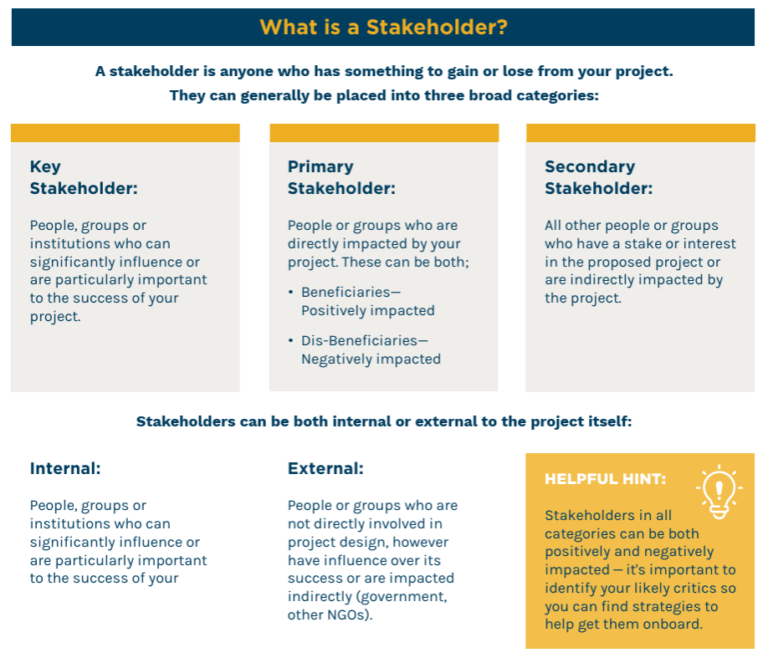
The following image is from Grassroots Collective: How to do a Stakeholder Analysis for Community Development
How to conduct outreach?
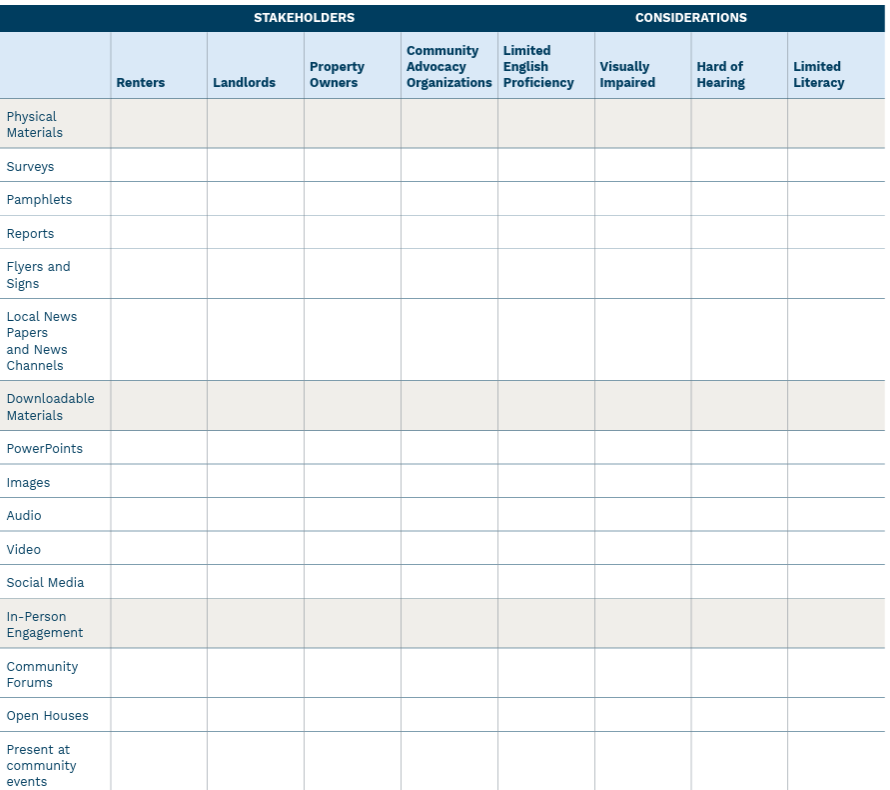
What outreach methods do you currently use? Where might gaps exist in how you engage with various stakeholders? Using the Outreach Methods and Stakeholder Types Matrix, identify your existing outreach methods for different stakeholder types. Populate the matrix headers with the stakeholders and population considerations you brainstormed in earlier activities in this workbook.
Find more guidance on how to construct engagement that responds directly to your community by downloading the workbook.
Assessing Community Needs
Start with listening sessions. They are like casual coffee chats where you can gather insights into the community’s priorities. It’s not about you talking, it’s about you listening — really listening. From these talks, pinpoint:
- What issues matter most to the community?
- Where do they need support or education?
- What type of engagement are they looking for?
As you gather this data, you’ll begin to see patterns that highlight the community’s heartbeat.
Customize Outreach Strategies
This is where your creativity kicks in. Your strategies should reflect the community’s vibe. If they’re business professionals, LinkedIn might be your golden ticket. If they’re local artists, maybe Instagram stories decked with their art is the way to go. Here’s what you can do:
- Create engagement opportunities that resonate on a personal level.
- Craft messages that echo the community’s voice and tone.
- Offer value that they can’t help but appreciate.
Who is responsible for outreach? How can you increase your outreach efforts? Using a capacity and needs assessment, you can identify where current staff capacity exists and where additional resources (money, staff time, expertise, etc.) are needed. Frame the assessment in terms of:
- The definition of capacity and any capacity development framework that is being applied in the particular context being assessed.
- The purpose of the assessment.
- The mandate of the entity to be assessed.
- Change readiness and stakeholder agreement about the need for the assessment.
Decide what to assess and how to analyze data. For example, think about:
- Levels of capacity: Whatever the starting point, going on to ‘zoom in and zoom out’ will lead to a holistic understanding of all the factors enabling or inhibiting performance and capacity change, (see below for an example).
- Types of capacity: Remember to assess both hard and soft capacities, including power distribution, incentives and sanctions, leadership, and values and beliefs.
- Themes for application: The capacity development framework will help to prioritize the areas for the assessment.
- PLUS, understanding gender and other cross-cutting issues can be essential to gaining a comprehensive assessment.
Choose the overall approach and specific tools.
- An incremental approach starting with identification of existing capacity as the foundation for identifying realistic steps forward, or
- A gap analysis starting with definition of how things ‘should be’, then looking at how they are and defining the difference between the two as what is missing, i.e. ‘the gap’.
There are many tools available for different aspects of assessment. They can and should be adapted to local context. The specific data needed and questions to ask will be determined by all the above factors.

How to fund outreach?
This budget template for outreach activities provides a structured outline for estimating costs. Categories include personnel, materials production, venue costs, and translation services. This tool allows staff to develop transparent and realistic budgets that support effective engagement, ensuring resources are used wisely to build trust and collaboration with the community. Complete the Word-adapted version of the template to build a budget for your outreach activities defined earlier in this workbook.
Additional Resources Hub
This resource hub provides tools and templates to help local governments and organizations design, implement, and evaluate effective outreach campaigns. Whether developing clear messaging, creating accessible educational materials, simplifying language, or establishing a monitoring and evaluation plan, these resources help ensure inclusive community engagement and measurable impact. Use these tools to streamline communication, remove barriers to participation, and track the success of outreach efforts.
Language accessibility resources help you avoid government-specific or policy jargon from outreach materials to ensure all audiences can access and understand the information your city provides.
- RESOURCE GUIDE: The U.S. Plain Language Action and Information Network has a site that offers guidance on plain language regulations, clear guidelines on ensuring compliance with plain language laws and requirements, and examples of plain language for diverse public offices.
- RESOURCE GUIDE: Public Input Webinar “From Complexity to Clarity: Engage and Inform Using the Plain Language Advantage” provides strategies and resources to improve community engagement through language accessibility.
- RESOURCE GUIDE: Harvard Catalyst Writing and Communication Center’s “Plain Language Materials Development Checklist” offers guidance and questions to consider when reviewing your materials for language clarity.
Sample messaging and communications plan: Develop a messaging calendar to produce and deliver timely information related to Healthy Rental Housing policies.
- EXAMPLE: The City of Moscow, Idaho 2024 Communication Plan is an example of a city communication plan, including metrics used to measure successful outreach.
- WORKSHEET: The Nonprofit New York: Sample Communications Calendar offers an Excel template download to build your local communications plan for Healthy Rental Housing policy outreach.
- WORKSHEET: The U.S. Office of the Administration for Children and Families: Social Media Calendar Template provides an Excel download with guidance on what content to produce, how to schedule, and consideration for various audiences.
Sample language and templates for education materials: Using language and materials that are engaging, accessible, and effective for community outreach ensures inclusive participation, the recruitment of local champions, and outreach approaches tailored to local community needs.
- RESOURCE GUIDE: The CDC Clear Communication Index is a health communication resource hub that provides guidelines and templates for creating clear, engaging, and accessible educational materials.
- RESOURCE GUIDE: The Community Toolbox: Creating Fact Sheets and Educational Materials is a resource from the University of Kansas that offers step-by-step guidance, sample language, and templates for developing effective community education materials.
- RESOURCE GUIDE: The Plain Language.gov Writing Guidelines is a federal government resource with sample templates and best practices for writing clear, accessible materials or diverse audiences.
Sample monitoring and evaluation plans and methods: Monitoring and evaluation (M&E) plan to ensure that outreach campaigns achieve their intended impact, track progress, and adapt strategies as needed.
- EXAMPLE: The CDC Program Evaluation Framework is a practical, nonprescriptive tool designed to summarize and organize essential elements of program evaluation.
- RESOURCE GUIDE AND WORKSHEET: The BetterEvaluation: Develop Planning Documents for Evaluation offers a wide range of methods, frameworks, and templates to help design, implement, and use an evaluation plan in outreach efforts.
