
By Tom Martin
Your health starts at home. But for millions of Americans, home can be a source of stress and strain.
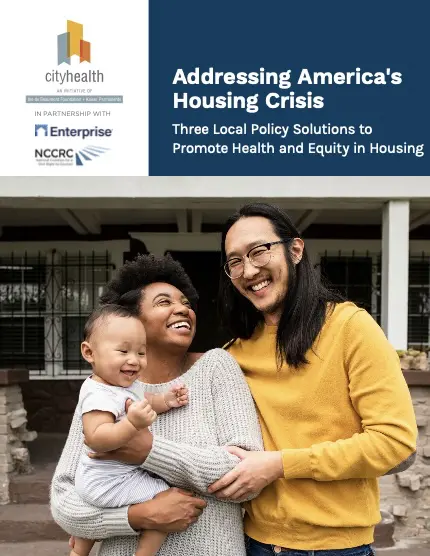
Deep Dive: Read CityHealth’s 2024 Housing Report
Housing costs have climbed steadily for years, while wages for many workers have barely kept pace. That gap is more than an economic problem; it’s a public health challenge. When rent consumes too much of a paycheck, families are forced into impossible tradeoffs: delay a doctor’s visit, skip the purchase of critical medications, cut back on groceries, or move into housing that is cheaper but less safe. Housing shapes the foundation for health and opportunity. It determines whether a child is exposed to mold or lead, whether a parent can afford both rent and insulin, whether an older adult can remain safely at home, and whether a family can recover after a financial shock or spiral into eviction.
Local leaders across the country are grappling with this reality. At nearly every major convening of elected officials, the conversation comes back to the same word: housing. But what they are really describing is a system under strain. Rising costs are pushing families into older, lower-quality homes. Stagnant wages make even modest rents difficult to sustain. And when households fall behind, the consequences of eviction, displacement, and homelessness carry lasting health impacts. These pressures do not fall evenly. Longstanding inequities in income, wealth, and access to opportunity mean that communities of color and lower-income households are more likely to face the combined burden of unaffordable and unhealthy housing.
That urgency has shaped CityHealth’s work from the beginning. Since 2016, housing has remained a central focus — not just increasing supply, but improving the quality, stability, and fairness of the housing system itself. Of the 17 total policies we’ve promoted over the past decade, nearly one-quarter have been dedicated to healthy housing: Affordable Housing/Inclusionary Zoning in our first policy package, and Affordable Housing Trusts, Healthy Rental Housing, and Legal Support for Renters in our 2.0 package. Across these four policies alone, CityHealth has awarded a cumulative 399 individual medals — a powerful sign that cities are leveraging policy to make housing more affordable, healthier, safer, and more stable. Together, these policies reflect a broad vision of what healthier housing requires: not just more homes, but homes that are affordable, safe, stable — and that lay the foundation for opportunity for all.
Affordable Housing/Inclusionary Zoning

Affordable Housing/Inclusionary Zoning was part of CityHealth’s inaugural policy package because it helps cities build affordability into growth. By requiring developers to set aside a share of homes for low- and moderate-income residents, inclusionary zoning helps ensure that new development creates opportunity for more people. This policy can be especially effective in “hot” housing markets, where rising demand can quickly put homes out of reach, but it is also a smart tool for cities to adopt before affordability pressures deepen.
Affordable housing is closely tied to health. It can help create more diverse, inclusive neighborhoods, reduce crowding and exposure to environmental hazards, and free up household resources for other essentials. Inclusionary zoning can also expand access to neighborhoods with strong schools, transportation options, and other community conditions that support health and well-being.
By the end of CityHealth’s first policy package, about one-third of assessed cities had earned a medal for this policy, including three gold, seven silver, and three bronze. Some cities had challenges with our policy criteria, which required policies to be mandatory, include meaningful affordability requirements, and evaluate results. As CityHealth developed its second policy package, Affordable Housing/Inclusionary zoning was replaced with three complementary housing policies that broadened the conversation beyond affordability alone to include housing quality, stability, and fairness.
Affordable Housing Trusts

Affordable housing under construction in Baltimore. Image credit: Robbie Becklund / iStockPhoto
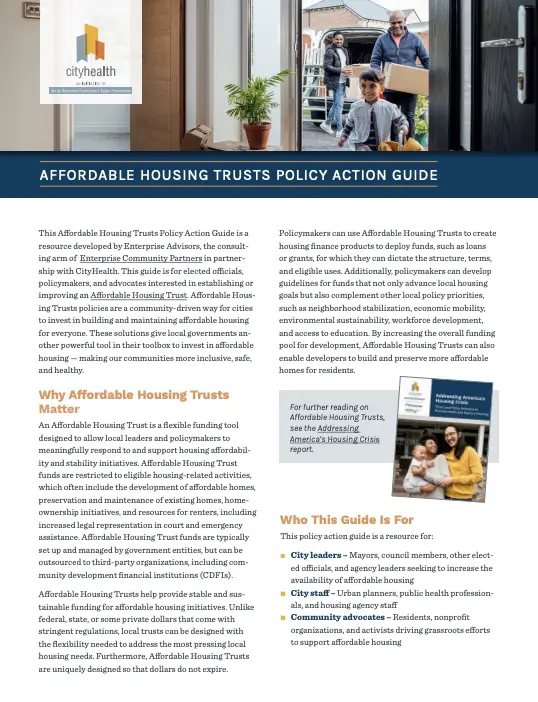
Go deeper: Download the NEW Affordable Housing Trusts Policy Action Guide
Affordable Housing Trusts help cities confront a hard truth: the market alone is not producing housing that people can afford, especially not on stagnant wages. These dedicated funds give cities the ability to invest directly in solutions, whether that means building new affordable homes, preserving existing ones, making critical repairs, or helping families stay housed. In an environment where even small rent increases can destabilize a household, that flexibility matters.
CityHealth’s 2024 housing report highlights the wide range of uses for trust funds, including affordable housing development, preservation and maintenance, homeownership support, emergency assistance, and renter protections. As of 2025, at least 132 city housing trust funds in 36 states were in operation. City housing trust funds generated more than $350 million in 2024, underscoring their growing role in expanding housing opportunity.
That flexibility is one of the greatest strengths of Affordable Housing Trusts. Unlike narrower funding streams, trust funds can help cities produce new affordable homes, preserve existing ones, make critical repairs, expand pathways to homeownership, and provide support that helps families remain stably housed. These are also investments in health. When housing costs are manageable, families are less likely to delay care, ration medication, or live in overcrowded or unsafe conditions. Stability creates room for everything else — work, school, and well-being.
Affordable Housing Trusts also give cities an important tool to advance equity. When paired with community engagement, clear affordability goals, public accountability, and strong oversight, these funds can help direct resources to the people and neighborhoods most affected by housing instability and historic disinvestment. Cities are increasingly using this tool to do just that: in CityHealth’s 2025 assessment, 46 of the nation’s 75 largest cities earned a medal for Affordable Housing Trusts, including 25 gold, 14 silver, and seven bronze.
Healthy Rental Housing
Video: See how Boston created one of the strongest Healthy Rental Housing policies in the nation.
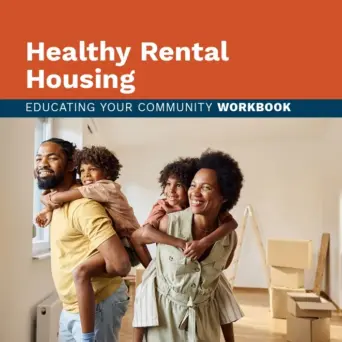
Healthy Rental Housing policies recognize a simple truth: everyone deserves a healthy home, and cities have a role to play in making sure rental housing is safe. These policies focus on the quality of rental housing by shifting away from complaint-based enforcement to proactive rental inspection and registration systems. Instead of waiting for serious problems to surface, cities can identify hazards earlier and bring substandard rental homes up to livable standards.
This is one of the clearest examples of how housing policy is health policy. Proactive inspection programs can help address conditions that directly threaten health, including pests, mold, moisture intrusion, poor ventilation, lead and other harmful chemicals, and unsafe structural conditions. These hazards can contribute to respiratory illness, injury, behavioral health challenges, and other negative health outcomes. But the burden does not fall equally. Renters with lower incomes are more likely to live in older homes with deferred maintenance, and complaint-based systems can leave out tenants who may be less able or willing to report problems because of fear of retaliation, language barriers, distrust of government systems, or immigration-related concerns. Pairing Healthy Rental Housing policies with an equity framework and supportive tools such as translation services, tenant relocation assistance, and culturally competent implementation can better protect residents most at risk of living in substandard conditions.
Healthy Rental Housing policies can also help cities preserve existing rental homes, support responsible property maintenance, and reduce housing instability caused by unresolved health and safety issues. Momentum is growing, but there is still more work to do: in CityHealth’s 2025 assessment, 23 of the nation’s 75 largest cities earned a medal for Healthy Rental Housing, including three gold, four silver, and 16 bronze.
Legal Support for Renters
Video: Learn how New Orleans’ Legal Support for Renters policy is changing outcomes for renters across the city.
Legal Support for Renters policies have a clear goal: making eviction proceedings fairer for tenants. That’s because eviction court is deeply unequal. Landlords almost always have legal representation, while tenants usually do not — a disparity that can shape whether a family remains housed or risks eviction. Legal Support for Renters policies, also known as a tenant right to counsel, help address that imbalance by ensuring that eligible tenants facing eviction have access to full legal representation. According to the National Coalition for a Civil Right to Counsel, only 4% of tenants are represented in eviction proceedings, compared with 84% of landlords.
That imbalance is also an equity issue. Communities of color experience eviction at disproportionate rates, meaning they are more likely to bear the consequences of a system that too often works against unrepresented renters. Legal Support for Renters policies can disrupt that pattern by giving tenants a fairer chance to raise defenses, negotiate better outcomes, protect their records, and avoid the severe financial losses that often follow an eviction filing. Legal representation can reduce rent debt, seal eviction records, improve credit-related outcomes, and strengthen long-term housing stability, including for renters who do need to move.
Ensuring a tenant right to counsel is a public health strategy. Having legal representation is a proven intervention that can keep more tenants housed, decrease the use of homeless shelters, and help renters move in ways that preserve long-term stability. That matters because eviction is not just a legal event; it can trigger a cascade of harms across health, employment, education, and future housing access.
Legal Support for Renters has seen growing momentum across the country; its one of the only policies in the current policy package that has seen a steadily growing number of medals in each assessment. As of 2025, 19 of the nation’s 75 largest cities earned a medal for Legal Support for Renters, including three gold, seven silver, and nine bronze — a sign that more cities are recognizing legal support as an essential part of healthier, more equitable communities.

Looking Forward
Ten years of progress have shown what is possible, but they have also clarified the scale of the challenge. Housing will not become healthier or more affordable on its own, especially as costs continue to outpace wages. Without deliberate action, more families will be pushed into instability, and the health consequences will deepen.
Cities have tools that work: building affordability into growth, investing in flexible funding, enforcing housing quality, and ensuring fairness in eviction proceedings. But taken together, these policies are helping to do something much larger — they are working to rebalance a system that has drifted out of reach for too many.
The question is no longer whether housing is a public health issue. We know it is. It is whether cities will continue to act with the urgency that this moment demands. Because when housing is out of reach, so is health. And when people cannot afford to stay in their homes, everything else — from work to school to community and stability — becomes harder to hold onto.
City leaders can use CityHealth’s policy framework and city assessments to see where progress is happening and where stronger action is needed. Advocates, partners, and residents can use these tools to push for change in their own communities. Because when cities invest in healthier housing, they are doing more than shaping the places people live. They are creating the conditions for all people to thrive.
Tom Martin is CityHealth’s communications director.